
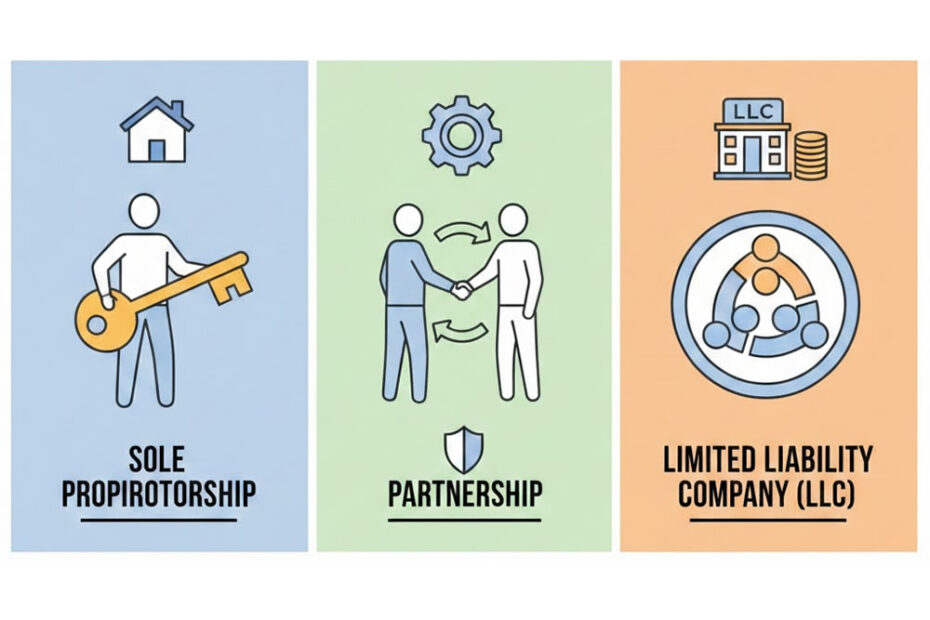
Choosing the right business registration and legal structure is one of the most important decisions any entrepreneur will make. It affects your legal liability, taxation, access to funding, credibility, compliance burden and long-term growth strategy.
Many business owners rush this decision because registration feels like a formality. It is not. Your legal structure shapes how you earn, how you are taxed, how you scale and how exposed you are to risk.
This guide provides a clear, practical comparison of sole proprietorship, partnership and limited liability company (LLC) structures. By the end, you will understand which option aligns with your risk appetite, financial goals and growth ambitions.
Why Your Business Structure Matters
Your legal structure determines:
-
Personal liability exposure
-
Tax obligations
-
Ability to attract investors
-
Access to loans and contracts
-
Regulatory compliance requirements
-
Succession and continuity planning
Choosing incorrectly can lead to:
-
Personal asset loss
-
Tax inefficiencies
-
Partnership disputes
-
Difficulty scaling
-
Investor resistance
Choosing correctly supports:
-
Sustainable growth
-
Financial protection
-
Clear governance
-
Long-term stability
A. Sole Proprietorship
A sole proprietorship is the simplest form of business ownership. One individual owns and controls the business.
Key Characteristics
-
Owned by one person
-
No legal distinction between owner and business
-
Simple registration process
-
Profits taxed as personal income
Advantages
-
Easy and inexpensive to set up
-
Full control over decisions
-
Minimal regulatory compliance
-
Direct access to profits
Risks and Limitations
-
Unlimited personal liability
-
Difficult to raise capital
-
Business ends if the owner dies or stops operating
-
Perceived as less credible for large contracts
If the business incurs debt or is sued, your personal assets — house, car, savings — are at risk.
Best Suited For
-
Freelancers and consultants
-
Small traders
-
Low-risk service providers
-
Side businesses testing viability
Common Mistakes
-
Mixing personal and business finances
-
Operating without insurance
-
Remaining a sole proprietor even after the business scales
Practical Tip: If your revenue or risk exposure increases significantly, reassess your structure immediately.
B. Partnership
A partnership is formed when two or more individuals agree to run a business together.
There are typically two types:
-
General partnership
-
Limited partnership
Key Characteristics
-
Shared ownership
-
Shared profits and losses
-
Joint decision-making (unless agreed otherwise)
-
Income passed through to partners for tax purposes
Advantages
-
Shared capital contributions
-
Shared expertise and networks
-
Shared workload
-
Easier funding than sole proprietorship
Risks and Challenges
-
Joint and several liability (in general partnerships)
-
Disputes over profit sharing
-
Unequal effort contributions
-
Business instability if one partner exits
In many cases, each partner can be held responsible for the actions of the other.
The Critical Document: Partnership Agreement
Operating without a formal partnership agreement is a major risk. It should clearly define:
-
Capital contributions
-
Profit-sharing ratios
-
Roles and responsibilities
-
Decision-making authority
-
Dispute resolution process
-
Exit and dissolution procedures
Best Suited For
-
Professional firms
-
Family businesses
-
Businesses where complementary skills are essential
Common Mistakes
-
Failing to formalise agreements
-
Equal ownership without equal contribution
-
Not defining decision-making authority
-
Ignoring exit planning
Practical Tip: Always involve a legal professional when drafting a partnership agreement. Verbal agreements are not a strategy.
C. Limited Liability Company (LLC)
A Limited Liability Company (LLC) is a separate legal entity from its owners (members).
This structure provides liability protection while maintaining operational flexibility.
Key Characteristics
-
Separate legal identity
-
Limited liability protection
-
More structured compliance
-
Flexible tax treatment (varies by jurisdiction)
Advantages
-
Personal asset protection
-
Greater credibility
-
Easier to attract investors
-
Business continuity independent of owners
-
Clear governance structure
If the business is sued or owes debts, members’ personal assets are generally protected (subject to legal compliance and no fraud).
Risks and Considerations
-
Higher registration and compliance costs
-
Annual filing requirements
-
More complex tax reporting
-
Regulatory obligations
Failure to maintain proper corporate records can lead to “piercing the corporate veil,” removing liability protection.
Best Suited For
-
Growth-focused businesses
-
Businesses with higher operational risk
-
Companies seeking investors
-
Long-term scalable enterprises
Common Mistakes
-
Treating the LLC like a sole proprietorship
-
Not maintaining separate bank accounts
-
Ignoring compliance deadlines
-
Under-capitalising the company
Practical Tip: Maintain strict separation between personal and business finances to preserve liability protection.
Direct Comparison: Sole Proprietorship vs Partnership vs LLC
| Feature | Sole Proprietorship | Partnership | LLC |
|---|---|---|---|
| Legal Identity | Not separate | Not separate (general) | Separate entity |
| Personal Liability | Unlimited | Usually unlimited | Limited |
| Setup Cost | Low | Moderate | Higher |
| Taxation | Personal income tax | Pass-through taxation | Flexible (varies) |
| Growth Potential | Limited | Moderate | High |
| Investor Attraction | Low | Moderate | High |
| Continuity | Ends with owner | Depends on agreement | Continues independently |
Real-World Decision Framework
When choosing your legal structure, ask:
1. What level of risk does my business carry?
-
Low-risk service? Sole proprietorship may suffice initially.
-
High-risk operations? LLC strongly recommended.
2. Do I plan to scale or seek investors?
-
Yes → LLC is generally more suitable.
-
No → Simpler structures may work short term.
3. Will I have partners?
-
If yes, formal agreements are non-negotiable.
-
Consider whether liability exposure is acceptable.
4. What is my long-term vision?
If you aim for:
-
Large contracts
-
Institutional funding
-
Cross-border operations
-
Structured growth
An LLC typically provides a stronger foundation.
Strategic Growth Considerations
Your legal structure is not permanent. Many successful businesses evolve:
-
Start as sole proprietorship
-
Convert to LLC when revenue grows
-
Introduce shareholders later if expanding further
The mistake is staying too long in an unsuitable structure.
Actionable Strategy:
-
Review your structure annually.
-
Reassess after major revenue increases.
-
Reassess before entering large contracts.
-
Reassess before bringing in partners.
Key Benefits of Making the Right Choice
Choosing the correct business structure:
-
Protects your personal wealth
-
Improves access to capital
-
Enhances credibility
-
Supports structured growth
-
Reduces internal conflict
-
Improves tax planning efficiency
It directly improves decision-making quality and long-term business stability.
Common Costly Errors to Avoid
-
Registering without understanding liability exposure
-
Choosing the cheapest option without strategic thinking
-
Ignoring compliance obligations
-
Failing to formalise partnerships
-
Mixing business and personal finances
-
Not seeking professional tax advice
Legal structure decisions made early can either strengthen or destabilise your enterprise for years.
Conclusion
Sole proprietorship, partnership and limited liability company (LLC) structures each serve a purpose. The right choice depends on your risk profile, growth ambition, capital needs and operational complexity.
If you are operating a low-risk, small-scale business, simplicity may work for now. If you are building for scale, attracting investors or protecting personal assets, an LLC often provides a stronger and more sustainable foundation.
Business registration is not just administrative paperwork. It is a strategic decision that shapes your financial security, growth trajectory and long-term stability.
Choose deliberately. Review regularly. Structure for where you are going — not just where you are today.