
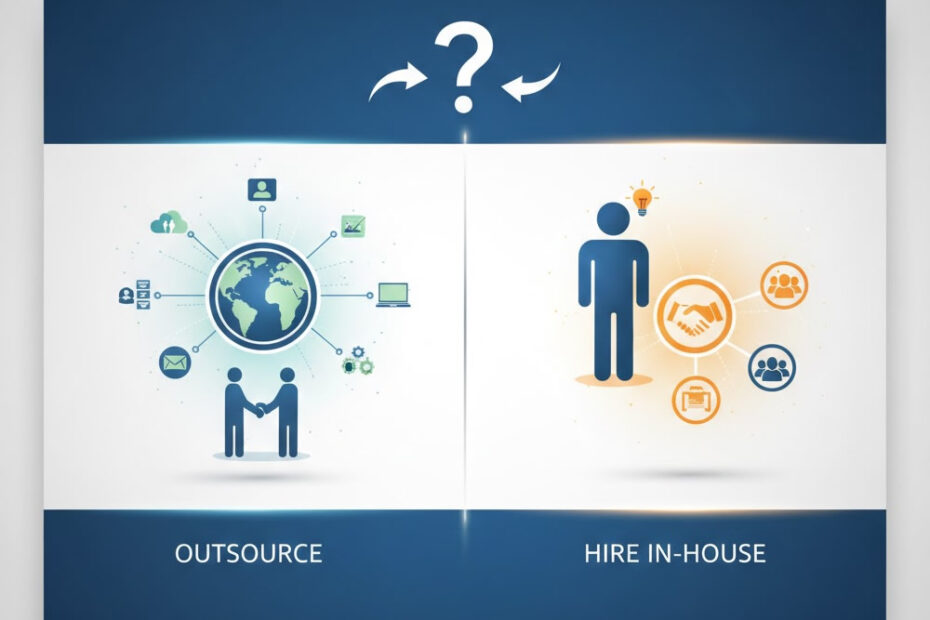
For small and medium-sized enterprises (SMEs), one of the most critical decisions in workforce planning is whether to hire in-house staff or outsource certain functions. This choice affects not only costs but also operational efficiency, talent access, and long-term growth. Making the right call requires a strategic understanding of both options and how they align with your business goals.
What’s the Difference?
In-House Teams
An in-house team consists of employees directly hired by your business. This model gives you complete control over work processes, quality standards, and company culture. It’s typically best suited for core business functions that drive your competitive advantage.
Outsourcing
Outsourcing involves contracting external providers to handle specific tasks or projects. This approach allows SMEs to access specialised skills, reduce costs, and scale operations quickly. Common outsourced functions include accounting, IT support, digital marketing, and administrative work.
Factors to Consider When Deciding
1. Cost Considerations
-
In-House: Includes salaries, benefits, training, equipment, and overheads. While upfront costs are higher, the long-term benefits can justify the investment for strategic roles.
-
Outsourcing: Usually has lower upfront costs and predictable fees. However, indirect costs like contract management, quality monitoring, and potential delays should be factored in.
2. Control and Quality
-
In-house teams provide direct oversight, making it easier to maintain quality and protect sensitive information.
-
Outsourcing can deliver high-quality results if the provider is reliable, but there’s less direct control. Clear contracts and service-level agreements (SLAs) are essential.
3. Flexibility and Scalability
-
Outsourcing allows businesses to expand or reduce capacity as needed, without long-term commitments.
-
In-house teams provide stability but are less adaptable to sudden changes in demand.
4. Access to Skills
-
Outsourcing opens access to specialist expertise that may be hard to find or expensive to hire internally.
-
In-house hiring develops company-specific knowledge, team cohesion, and long-term capability.
5. Strategic Impact and Growth
-
Core functions that define your business strategy are usually best kept in-house.
-
Routine or non-core tasks are prime candidates for outsourcing, freeing internal resources to focus on growth and innovation.
How to Make the Right Choice
-
Identify Core vs Non-Core Functions
Determine which tasks directly impact your competitive advantage. Keep core functions in-house and consider outsourcing the rest. -
Run a Cost-Benefit Analysis
Compare the total costs of in-house versus outsourcing, including hidden costs such as management time, infrastructure, and training. -
Assess Risks and Compliance
Sensitive functions, regulatory requirements, or intellectual property concerns may necessitate in-house management. -
Test with a Pilot Project
Consider starting with a small outsourcing trial to evaluate quality, responsiveness, and fit before fully committing. -
Consider a Hybrid Model
Many SMEs combine both approaches: strategic functions in-house, specialised or temporary tasks outsourced. This balances control, efficiency, and cost-effectiveness.
Conclusion
Choosing between outsourcing and hiring in-house is a strategic decision with long-term implications for your SME. By evaluating costs, control, talent access, and growth priorities, business leaders can make informed decisions that optimise resources, strengthen operations, and support sustainable growth.
A well-considered workforce strategy today will define how effectively your SME competes and scales tomorrow.